
RISK MANAGEMENT PLAN

International Football Tournament Stadium & Digital Ticketing Project

  1. Document Information
  • Project Manager: Alex
  • Version: 1.0
  • Approval Date: 08 December 2025
  • Status: Approved – Controlled
  • Parent Document: Project Management Plan
  1. Purpose

This Risk Management Plan defines:

  • How risks will be identified
  • How risks will be analyzed (qualitative & quantitative)
  • How responses will be developed
  • How risk reserves are allocated
  • How risks will be monitored and controlled

Objective:

Minimize negative impacts and maximize opportunities to protect the tournament delivery date and national reputation.

  1. Risk Strategy

The project adopts a proactive risk posture:

  • Early identification
  • Transparent reporting
  • No hidden buffers
  • Quantified exposure where feasible
  • Governance-aligned escalation
  1. Risk Categories (Risk Breakdown Structure – RBS)
  2. Technical Risks
  • Turf certification failure
  • Integration incompatibility
  • Performance scalability limits
  1. Construction Risks
  • Steel price volatility
  • Weather delays
  • Safety incidents
  1. Digital & Cyber Risks
  • Security vulnerabilities
  • API vendor dependency
  • Load testing failure
  1. Regulatory & Governance Risks
  • Inspection delays
  • Policy changes
  • Political interference
  1. External Risks
  • Global material market changes
  • Economic instability
  • Labor shortages
  1. Organizational Risks
  • Key resource turnover
  • Decision-making delays
  1. Risk Identification Process

Risks are identified through:

  • Expert judgment
  • Brainstorming workshops
  • Lessons learned from prior stadium projects
  • Document analysis
  • Assumption analysis
  • Interface reviews (hybrid dependency workshops)

Risks are logged in the Risk Register.

  1. Qualitative Risk Analysis

Each risk is assessed using:

  • Probability (Low / Medium / High)
  • Impact (Cost / Schedule / Quality / Reputation)
  • Urgency
  • Detectability

Risk Rating = Probability × Impact

Risks classified as:

  • Low
  • Moderate
  • High
  • Critical

Only High & Critical risks proceed to quantitative analysis.

  1. Quantitative Risk Analysis

Applied to major cost/schedule drivers:

  • Steel price volatility
  • Turf installation
  • Integration chain
  • Regulatory approval

Techniques used:

  • Expected Monetary Value (EMV)
  • Three-point estimating
  • Monte Carlo simulation (for schedule sensitivity)

Outputs:

  • Contingency allocation
  • Risk exposure trend
  • Sensitivity ranking
  1. Risk Response Strategies

For Threats

  • Avoid
  • Mitigate
  • Transfer
  • Accept

For Opportunities

  • Exploit
  • Enhance
  • Share
  • Accept

Hybrid example:

  • Steel volatility → Mitigate (hedging contract)
  • Turf rejection → Mitigate (pre-certification testing)
  • Integration delay → Mitigate (early interface testing)
  • Early digital adoption → Exploit
  1. Risk Ownership

Each risk must have:

  • Risk Owner
  • Response Owner
  • Trigger conditions
  • Monitoring frequency

Risk owners are accountable for response execution.

  1. Contingency & Reserves

Financial contingency:

$24,000,000 (included in cost baseline)

Time contingency:

Defined in Schedule Data

Management Reserve:

$15,000,000 (Sponsor controlled)

  1. Risk Thresholds

Escalation required when:

  • Risk exposure > $5M
  • Schedule impact > 30 days
  • Risk affects tournament milestone
  • Reputational risk becomes visible externally
  1. Risk Monitoring & Control

Risk reviews occur:

  • Monthly (formal)
  • Before major milestones
  • After major change requests
  • After contingency use

Activities include:

  • Risk re-scoring
  • Residual risk analysis
  • New risk identification
  • Contingency tracking
  1. Integration with Other Plans

Risk Management interacts with:

  • Cost Management Plan
  • Schedule Management Plan
  • Quality Management Plan
  • Procurement Plan

Risk responses may require:

  • Change requests
  • Baseline adjustments
  • Sponsor escalation
  1. Risk Reporting

Risk reporting includes:

  • Top 10 risk dashboard
  • Exposure trend
  • Reserve status
  • Emerging risks

Reported to:

  • PMO (monthly)
  • Sponsor Committee (quarterly)
  1. Roles & Responsibilities

Role

Responsibility

Project Manager

Overall risk accountability

Risk Officer

Risk tracking & analysis

Construction Lead

Construction risk ownership

Digital Lead

Technical & cybersecurity risk

Sponsor Committee

Escalated decision authority

  1. Risk Documentation Requirements

Each risk must include:

  • Description
  • Category
  • Root cause
  • Impact area
  • Response strategy
  • Owner
  • Status
  • Reserve allocation (if applicable)
  1. Risk Review Milestones

Formal risk review required at:

  • Completion of foundations
  • Completion of superstructure
  • Turf installation
  • Gate integration
  • Pre-handover
Scroll to Top

Close Project or Phase

The process of finalizing all activities and formally completing the project.

Lessons Learned Register

A document capturing knowledge gained during the project (click to see exemple).

Operational Readiness

The degree to which operations can support and sustain the delivered product.

Handover to Operations

The formal transfer of ownership, responsibility, and risk from the project to operations.

Integrated Change Control

The process of reviewing and approving changes across the project.

Change Request

A formal proposal to modify project baselines or plans.

Issue

A current condition that is already affecting the project.

Work Performance Report

A document summarizing performance information for stakeholders (click to see exemple).

Work Performance Information

Performance data analyzed and integrated to provide context (click to see exemple).

Work Performance Data

Raw observations and measurements collected during project execution (click to see exemple).

Control Procurements

the process of managing procurement relationships and contract performance.

Claim

A formal request for compensation or time adjustment under a contract.

Liquidated Damages

Pre-agreed penalties for failure to meet contractual obligations.

Compensable Delay

A delay that entitles the seller to additional time and/or money.

Excusable Delay

A delay allowed without penalty under the contract.

Force Majeure

A contract clause excusing performance due to unforeseeable events beyond control.

Procurement Management Plan

A document describing how goods and services will be acquired (click to see exemple).

Workaround

An unplanned response to a risk that occurs when no planned response exists.

Expected Monetary Value

A risk analysis technique calculating average outcomes (click to see exemple)

Quantitative Risk Analysis

Numerical analysis of the combined effect of risks on project objectives (click to see exemple).

Residual Risk

Risk remaining after responses have been implemented.

Risk Register

A document listing identified risks, responses, and owners (click to see exemple).

Risk

An uncertain event or condition that may affect project objectives.

Quality Expectations

Stakeholder perceptions of acceptable performance beyond formal standards.

Quality Standards

Mandatory specifications that must be complied with.

Quality Management Plan

A document describing how quality policies, standards, and requirements will be met (click to see exemple).

Benefit–Cost Ratio

The ratio of expected benefits to expected costs.

Payback Period

The time required to recover the initial investment.

Internal Rate of Return

The discount rate at which NPV equals zero.

Net Present Value

The value of future cash flows discounted to today.

Return on Investment

A financial measure comparing the net benefit of an investment to its cost.

Management Reserve

Time or cost set aside by management for unforeseen work, not included in the baseline.

Contingency Reserve

Time or cost set aside for identified risks.

Cost Baseline

The approved version of the project budget used for monitoring and control.

Critical Path

The longest sequence of dependent activities that determines the shortest project duration.

Lag

The amount of time an activity is delayed relative to its predecessor.

Lead

The amount of time an activity can be advanced relative to its predecessor.

Rolling Wave Planning

A planning approach where near-term work is planned in detail and future work at a higher level.

Schedule Management Plan

A document that establishes how the schedule will be developed, monitored, and controlled (click to see exemple).

Activity-on-Node Network

A schedule network diagram where activities are represented by nodes and dependencies by arrows (click to see exemple).

Define Activities

The process of identifying and documenting specific actions needed to produce deliverables.

Decomposition

The technique of subdividing deliverables and work into smaller, more manageable components.

WBS Dictionary

A document providing detailed information about each WBS component (click to see exemple).

Work Breakdown Structure

A hierarchical decomposition of the total scope of work into manageable components (click to see exemple).

Project Scope Statement

A detailed description of the project deliverables, boundaries, and acceptance criteria (click to see exemple).

Requirement Traceability Matrix

A table that links requirements to their origins and corresponding deliverables (click to see exemple).

Requirements Documentation

A detailed description of individual stakeholder requirements (click to see exemple).

Requirements Management Plan

A document that defines how requirements will be collected, analyzed, tracked, and reported (click to see exemple).

Scope Management Plan

A component of the project management plan describing how scope will be defined, validated, and controlled (click to see exemple).

Phase Gate

A review point at the end of a phase where continuation is approved, modified, or terminated.

Project Phase

A collection of logically related project activities that culminates in the completion of one or more deliverables.

Project Life Cycle

The series of phases a project passes through from initiation to closure.

Tailoring

the deliberate adaptation of project management processes to fit the project’s context, size, and complexity.

Organizational Process Assets

Plans, processes, policies, procedures, and knowledge bases specific to the organization.

Enterprise Environmental Factors

Conditions not under the control of the project team that influence or constrain the project.

Psychological Safety

A shared belief that the team is safe for interpersonal risk-taking.

Servant Leadership

A leadership approach focused on serving the team by removing obstacles and enabling performance.

Leadership

The ability to guide, motivate, and enable others to contribute toward project success

Salience Model

A stakeholder classification model based on power, legitimacy, and urgency (click to see exemple).

Stakeholder Engagement Assessment Matrix

A tool that compares current and desired stakeholder engagement levels (click to see exemple).

Power Interest Grid

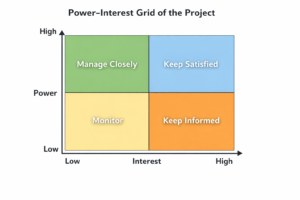
A stakeholder analysis tool that categorizes stakeholders based on their level of authority and interest (click to see exemple).

Stakeholder

An individual, group, or organization that may affect, be affected by, or perceive itself to be affected by a project.

Assumption Log

A document used to record assumptions and constraints throughout the project lifecycle (click to see exemple).

Benefits Management Plan

A document that defines how benefits will be delivered, measured, and sustained (click to see exemple).

Business Case

A documented economic justification for the project that explains the expected benefits, costs, and risks (Click to see exemple).

Project Charter

A document issued by the sponsor that formally authorizes the project and grants the project manager authority to apply organizational resources.

Directive PMO

A PMO that directly manages projects and assigns project managers

Controlling PMO

A PMO that requires compliance with standards and frameworks

Supportive PMO

A PMO that provides guidance and templates with low control.

Project Management Office

An organizational structure that standardizes project-related governance processes and facilitates the sharing of resources, methodologies, and tools.

Strong Matrix Organization

An organizational structure where project managers have high authority and full-time project staff, while functional managers retain limited control.

Legitimacy

The recognized and accepted right of an individual or group to exercise authority.

Accountability

The obligation to answer for outcomes and consequences, regardless of who performed the work.

Authority

The right to make decisions and commit organizational resources within defined boundaries

Governance Path

The defined escalation and decision-approval route through which issues, risks, and changes move within the organization.

Project Governance

The framework of rules, roles, decision-making authority, and oversight used to align the project with organizational strategy and ensure accountability.

Portfolio

A collection of projects, programs, and operations managed as a group to achieve strategic objectives

Program

A group of related projects managed in a coordinated way to obtain benefits not available from managing them individually.

Project Manager

The person assigned by the performing organization to lead the team responsible for achieving project objectives.

Project

a temporary endeavor undertaken to create a unique product, service, or result

Title

Aaaaaaaaaaaaaaaaaaaaaaaaaaaaaaaaaaaaaaaaaaaaaaaaaaaaaa

aaaaaaaaaaaaaaaaaaaaaaaaaaaaaaaaaaaaaaaaaaaaaaaaaaaaaaaaaa

Ministry of Sports

a public-sector organization responsible for national sports infrastructure and programs